Saturday, May 31, 2003
[161.2] REFLECTIONS IN D
In the category of 'discovered because it kindly linked to NFE' is the weblog 'Reflections in D', which is about life as much as music. Not that the two are always unrelated... Lynn Sislo has recently written a piece in response to the thoughts of A. C. Douglas on contemporary art music. Her own experience is, of course, part of the wider conversation about why people with adventurous artistic tastes in other fields struggle with 'modern' music. In Lynn's instance, Elliott Carter and Alfred Schnittke pushed some buttons. I enjoyed her comment that "I've been told that Schnittke's music is tonal, but ... I can't always tell just by listening" -- resonances of the famous "Wagner's music is better than it sounds"! She is also a good trawler. I'm currently looking at material on the ("gives me the creeps" -- LS) Institute for Music and Brain Science. And the title? "Many of my favorite musical compositions are in d minor. As all music lovers know, minor keys tend to be "dark." D minor has always seemed to me somewhat ambiguous. Is it tragic, melancholy, depressed, lonely, disturbed, anxious, somber or merely playfully dark and spooky? In various works it is all of these things. I don't intend for my "Reflections" to be generally dark but I rather like the idea of ambiguity. "

[161.1] QUOTA BENE
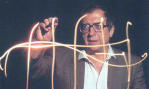
(c) J Wolf 2003
"[His] music [was of] unarguable intergrity; emotion informed and achieved through intellectual rigour and curiosity... [He] marched joyously in his own direction." Composer Michael Berkeley pays tribute to Luciano Berio (1926 - 2003)
Obituaries: International Herald Tribune (Paul Griffiths); Guardian (Ivan Hewlett).
Thursday, May 29, 2003
[160.2] ALL THAT JAZZ
NFE has had cause to comment recently on the prodigious (and relatively overlooked) modal and improvisational piano talents of veteran jazzman Andrew Hill. At 23:30 tonight (Friday), 'Jazz on 3' broadcasts the whole of his recent Barbican concert, through to 01:00 on Saturday. Definitely worth catching on the net -- or, if you are so inclined, pick it up later on the BBC Radio 3 playback site. Similarly, 'Jazz Legends' (from 16:00 - 17:00) features excerpts from a recently unearthed recording of a legendary gig featuring Dizzy Gillespie, Charlie Parker, Bud Powell, Charles Mingus and Max Roach... from 50 years ago this month. The programme is introduced by classically-trained jazz polymath, Julian Joseph. Coming up in June on 'Jazz on 3' - the live and contrasting saxophonic delights of Peter Brotzmann (free and wild) and Jan Garbarek (cool and calculating). BBC Radio 4, a quality talk station, pulls in over 17 million listeners weekly, according to the latest electronic research. Radio 3 is, by such standards, the merest blip of the airwaves... but what tremendous quality it exhibits in classical, jazz, new and world music.
[159.1] AN AFFECTIONATE MEMORY
While reading through the initial Luciano Berio obituaries, I came across this touching Berio story from Lynn David Newton's website. Read it for yourself...
He also includes a section called 'Selah' (Hebrew for 'pause for thought', and employed as a metrical reading device in Psalmody) which details his musical autobiography. It is an enquiring and enthusiastic journey across the traditions of the sort that music education at all levels should be encouraging right now.
Good to note, inter alia, that the UK government seems now to be recognising the deleterious impact of its cuts in schools-based music education, and is showing signs of restoring that balance within the national curriculum. There's a long way to go, however. Meanwhile, ISME does an important job at the international level.
Wednesday, May 28, 2003
[158.2] LUCIANO BERIO IS DEAD
Very sad news just in (via Charles Imperatori, the BBC Radio 3 bulletin board classical section, and an article USA Today) - Luciano Berio died late yesterday, ostensibly from post operational complications after having undergone surgery on his spine at the Gemelli hospital in Rome. Berio was undoubtedly the greatest living Italian composer, and one of the true greats of the twentieth century. He will be sorely missed.
Berio, who was also a conductor, was particularly noted for innovations in electronic music. He taught courses on electronic music at Columbia University in New York. He was a co-founder of the Musical Phonology Studio at RAI state television in Milan in 1955, at a time of significant electro-acoustical exploration. Berio was in the news last month about Myung-Whun Chung's decision not to renew his contract at principal conductor at St. Cecilia when his contract runs out in 2005. Other top posts for Berio included director of the Maggio Musicale Fiorentino. See also the Daily Telegraph.
[158.1] FIELDS OF GOLD?
The London Underground, one of the busiest metros in the world, is auditioning buskers for 200 'legal' slots at tube stations across the capital. Priority is being given to 'old hands'. LU previously tried to outlaw 'the independent music sector', but surveys have shown that 8 out of 10 passengers are in favour street music -- provided the quality is sufficient, and they do not feel harassed.
Among those who will benefit are hard-up students from London's music colleges, who help pay their tuition and residence fees by busking a few pennies of tourists and commuters in high season. Charing Cross is a favourite site for string ensembles, it seems. In the classical field, excerpts from Vivaldi's 'Four Seasons' are, unsurprisingly, among the favourite lollipops -- the equivalent of song staples like 'Yesterday' and (shudder) 'Streets of London'.
One practiced busker -- whose current day job includes mastering composition classes -- told NFE that there was now a definite Vivaldi downswing, however. "People frustrated at being 'put on hold' by phone management systems and call centres have started to develop a definite aversion," she explained. "I do hope LU continue and extend this licensing system," she added. "Live music is infinitely preferable to the mind-numbing musak that gets pumped into many public places these days."
But what about the less commercial street sound stream? While songs by the Davids Gray and Bowie are the proven kind of thing to attract loose change into the ubiquitous busking hat, some musical surprises can be forthcoming, too... like the guitarist picking out a theme from Michael Nyman's 'Piano Concerto', and the bass player who was recently heard ripping shards off a terrifying Godspeed! You Black Emperor cut. For such daring visionaries mindless populism just isn't worth an easier price for a cuppa. So please be extra generous to them.
Meanwhile, rumours that Brian Fernheyhough is carting his flute down to Notting Hill Gate were unconfirmed when NFE went to press. Or was that to bed...?
Tuesday, May 27, 2003
[157.1] BOILING UP FOR MELTDOWN 2003…
I still have my (now rather ‘period’ gauche-looking) sweatshirt from the first ever Meltdown festival on the South Bank. It was way back in 1993, and the concept was both simple and revolutionary: a truly diverse, eclectic modern music event curated by a single composer or performer/artist. The main idea – or was it simply an easy-going opportunity - was to make demanding, modern music accessible; to clothe artistic commitment in multi-media, multi-perspectival limelight; to widen perceptions, tastes and critical faculties among audience, performers and critics alike. In short, to redefine what we mean by ‘serious’ in music.
The climate was absolutely right. The austerity of early modernism was passed, but its benefits had seeped into the bloodstream. Post-minimalism was breaking out. It felt OK to like Boulez and Faust, Miles Davis and the London Musicians’ Collective. The old maps no longer worked. It wasn’t that ‘anything goes’ thing alone, but an awareness that some surprising things could be, endure even.
For the record, the previous Meltdown Directors are David Bowie (2002), Robert Wyatt (2001), Scott Walker (2000), Nick Cave (1999), John Peel (1998), Laurie Anderson (1997), Magnus Lindberg (1996), Elvis Costello (1995), Louis Andriessen (1994) and George Benjamin (1993). That tells an interesting story in itself. Three out of the first four were what would be called (badly, wrongly even) ‘classical’ composers. None of the last six (seven if you include 2003) have been. All are experimenters, sure, but latterly in fields that overlap prominently into the mainstream. Not a single jazzer, outright free-form extemporiser or techno warrior in sight – in ten years. Something starts to feel a little lopsided…
Then again, Meltdown 2003 is not without appeal. Running (as usual) at London’s South Bank Centre concert halls and platforms from 10 to 29 June 2003, the animateur this time is dub doyen Lee ‘Scratch’ Perry, a musician, songwriter, reggae legend and producer of such artists as The Clash and Bob Marley and the Wailers. He has assembled a suitably quixotic array of performers and some extraordinary confrontations. Tortoise, Public Enemy, and the legendary Arkestra (minus their late demi-god, Sun Ra, of course) are all deployed in downright curious contexts and formations. The theme seems to be ‘stand offs’. Music over ten or more rounds with no clinches barred.
Well, some clinches are barred. For somehow the 2003 line-up is not quite enough for the true width of a Meltdown experience. Jazz (as I've already indicated) is hinted at only tangentally, and more as an ethos than a musical inheritance. Contemporary composition is wholly absent. Those have been developing trends of recent years, and they are to be regretted. Perry himself also uses the opportunity to ‘join in’ perhaps a little too lavishly. From a celebration of new music which is artfully purposeful without being reverentially serious, Meltdown has become a 'virtual installation' for the more creative fringes of popular music, laced with some obvious crowd-pleasers (Macy Gray comes to mind), the inevitable commercial sponsors, the promise of some gripping collaborations for a curator who is otherwise paid little, the Flash website, and a decisive dash of nu-urban uber-hip. It's more than OK for what it is, and exciting at times -- but it's not nearly as edgy, sparky or (say the blessed word!) downright challenging as what might have been.
So come on guys, share out the shades and give it to Ollie Knussen or Harry Birtwistle next year. Or Ornette Coleman, perhaps. Or Aphex Twin, for goodness sake. ‘Cos wouldn’t we all really like to know what Knussen digs on the turntablism scene? And if he doesn’t actually know yet, put him through a ‘Secret Jukebox' routine a la The Wire, or set the artistic director of the London Sinfonietta and Warp Records onto to his CD collection: the results could be mind blowing. But the way things are going it might just end up with Ali G and da RFH Massiv… Wesside, but not South Bank.
PS. Some of the Free Meltdown looks pretty groovy in its own, distinct way.
Sunday, May 25, 2003
Saturday, May 24, 2003
[156.1] LIGETI UPDATE
Stefan Beyst's penetrating Ligeti analysis, 'Adventures: Ode to the discrepancy between word and deed' can be found in English here. See also the precis and sound samples ('Lux Aeterna', "Presto ruvido" from 'Six Bagatelles for Wind Quintet') on EssentialMusic; song texts; the BBC Ligeti profile [plus quotation on micropolyphony]; some Ligeti editions on Sony; the Pitchfork review of 'The Ligeti Project II'; and Nicholas Lezard's Guardian review of 'György Ligeti: Music of the Imagination', by Richard Steinitz, 429pp, Faber, £25. There is also a feature on the book in the June issue of The Wire.
Friday, May 23, 2003
[155.1] GET CARTER
ECM has come up trumps again with 'Lauds and Lamentations', a superb double disc of works by Elliott Carter (still going strong) and Isang Yun (who died in 1995). At the heart of the collection are two contrasting Oboe Concertos, one by each composer. Both were written for Heinz Hollinger, a performer of extraordinary intensity and deftness. The Carter work was "spun out of invention" (Andrew Clements) in 2001. His '4 Lauds' (featuring Thomas Zehetemair on violin), 'A 6 Letter Letter' and 'Figments One and Two' stand in parallel to Yun's telegrammatic, gut wrenching solo, 'Piri'. On the Carter disc Hollinger takes notes from conductor Paul Sacher's name and fashions out of it a continuous motif for cor anglais. These discs harbour refrains and redoubts to boggle the mind and entrance the ear.
Incidentally, John F. Fink's highly developed website, Elliott Carter: A Guide to Research, is essential reading on the man and his music. It contains a fully annotated bibliography, a detailed discography, and a complete list of works, as well as appendices. The bibliography includes video recordings and interviews in addition to books and articles. A separate section on Carter's own writings is arranged alphabetically by title. Other Carter-Hollinger colaborations are detailed in the addenda.
:: Friday, May 23, 2003 ::
[154.1] ZORN AND RODRIGUEZ SYNERGIZE
Constitutional musical maverick John Zorn's compositional and saxophone talents effortlessly traverse the worlds of contemporary classical, freeform jazz, avant post-rock and breakneck cartoon freakery. Frankly, you never know what he's going to come out with next -- which makes his decision to team up with vituosic Cuban percussionist Roberto Juan Rodriguez perfectly predictable in its sheer unpredictability. The pair assemble two equally intriguing cross-sections of musical fauna at the Barbican Centre on the evening of Sunday 20 July. Zorn's band, which includes shimmering guitarist Marc Ribot, effects to disassemble and reassemble traditional Jewish sounds, while Rodriguez combines horns, strings and David Karkauer's klezmer-style clarinet. Percussive wizardy welds the projects together in an orgy of differance. Two zeds and a couple of noughts. Not to be missed...
While you're about it, why not visit Tzadik, Zorn's radical cultural site, "dedicated to releasing the best in avant garde and experimental music, presenting a worldwide community of contemporary musician-composers who find it difficult or impossible to release their music through more conventional channels"? A cause definitely worth supporting.
Thursday, May 22, 2003
[153.1] SUB-BASS PARTICLES?
'Infrasound' is a sub-sonic bass system which utilises bodily sensation to reproduce the aural impact of bass notes which actually resonate at a lower frequency than is strictly discernible to the human ear. Or something like that. As we all know, sound is airwaves anyway, but the basic issue is that -- channelled in a certain way and in a wider aural context -- infrasound gives us the capacity to respond to notes we can't hear as such, though we may pick up 'overtones' in combination with the physical resonance. Anyway, as you can tell, I'm way out of my explanatory depth here, and hopefully a sonic engineer will sort out the misconceptions involved in this rather sketchy description. I'm consoled that a certain press office couldn't really explain it either!
The point is that the innovative South Bank Centre in London has a couple of upcoming events that put infrasound into action. The focus is a Ravi Deepres film installation on 31 May: "This concert for piano, electronics and visuals is also a live psychology experiment. Some of the music is laced with infrasound (extremely low-pitched sound). A giant generator, in the auditorium, will produce some of the deepest bass notes ever performed while questionnaires monitor the audience's reaction. Featuring piano music by Debussy, Glass, Part, Satoh and Tanaka. Including the world premiere of a piece specially written for the experiment." This event is repeated twice (from 3pm), with a discussion in the middle.
Looks good, huh? There is also a dramatic warning notice about side effects and pregnancy (basically they shouldn't occur, but don't try to sneak unborn kids into the auditorium, OK?)... A friend who has 'heard' an infrasound-assisted performance gave the metaphoric description of 'experiencing sub-bass particles'. Apart from melting subcutaneous fat in the brain, then, it seems that infrasound lends new sense to the popular refrains "you had to be there" and "did the earth move for you?"
Meanwhile, when NFE is in a less jocular mood, we will offer a much more satisfactory, learned musicological discourse on this development. As always. (No doubt most of you already know this stuff, since it's been kicking around the electronic music labs for literally *weeks*)... The nearest I've got so far is this NOAA definition: "Infrasonics is the study of sound below the range of human hearing. These low-frequency signals are produced by a variety of geophysical processes including earthquakes, severe weather, volcanic activity, geomagnetic activity, ocean waves, avalanches, turbulence aloft, and meteors and by some [hu]man-made sources such as aircraft and explosions."
You have been warned. The old sub-woofer may never sound the same again.
Wednesday, May 21, 2003
[152.1] DIFFERENT STROKES
An enterprising programme of new music comes under the baton of London Sinfonietta laureate conductor (and adjunct composer) Oliver Knussen on Thursday 22 May at London's Queen Elizabeth Hall. Featured works include the premiere of Alexander Goehr's 'Marching to Carcassone', plus '...about Stravinsky'. Goehr was one of Knussen's own teachers. Then there is Detlev Glanert's experimental chamber sonata, 'Secret Room', and Charles Wuorinen's 'Cyclops'. Wuorinens says this piece is like the stock market, "because it proceeds in fits and starts"! The soloist is Peter Serkin on piano. It promises to be a fascinating and demanding evening.
Tuesday, May 20, 2003
[151.2] MORTAL KOMBAT TOO
Notorious-but-nice soprano Adey Grummet writes: "Another gig... Kombat Opera Klubneit is part club, part psycho recital. Richard Thomas ('Tourette's Diva' and 'Jerry Springer - The Opera') unleashes his epic urban song cycle. Very weird. Very funny. See you there? I'm the one who's not a goth or in bling. I'm in a caftan." Details: Friday 23 and Saturday 24 May at the Battersea Arts Centre in London. Box Office 020 7223 2223.
Adey can also be heard on the new CD from multi-voice orchestra The Shout, 'On Arrival'. She lends her time to spnm (what used to be called the Society for the Promotion of New Music, but is now more lower case and less prosaic...). And she was fabulous in the BAC's 'Jerry' too. See NFE on the latest JS production.
Monday, May 19, 2003
[151.1] OPERA CLONED THE VIDEO STAR?
The imminent advent of John Adams' 'Klinghoffer' on TV (Channel 4, UK, Sunday 25 May, 18:55 -- slightly later than it was advertised before) raises the question of past opera-for-TV experiences. The precedent is mixed. Back in December 2000, for example, Channel 4 screened a film version of a highly acclaimed Glyndebourne youth opera, 'Zoe' (with music by John Lunn). The reviews were great [see Duncan Hadfield on MusicWeb for the whole story]. Richard Morrison of The Times declared it "a magnificently atmospheric score, cleverly conceived for young players." But in ratings terms it bombed: just 300,000 viewers. The overall terrestial audience share for the channel went down to only 1%, a tenth of its usual average.
Now I'm biased on this one -- librettist Stephen Plaice hangs out in my neighbourhood -- but this doesn't seem at all bad for a specialist art form in the age of niche and narrowcasting. However, since the advertisers definitely wouldn't wear the recent 600,000 audience for a highly-publicised contemporary version of Shakespeare's 'Twelfth Night', Adams will need to pull at least 800,000 to cross the TV executive acceptability threshold. The signs are that it definitely deserves to do so. Whether it will is another matter.
Britten, Gian Carlo Menotti and Jonathan Dove are among the distinguished composers who have been involved in writing opera for TV before. But it is a difficult trick to pull off. Somehow the technology, the overlayed art forms and the intrinsic drama needed to make a TV opera take off don't gel readily. If Adams' musically accessible singalong-a-docu-soap doesn't help create a new genre, probably nothing will. 'Jerry Springer' (see NFE passim) is just too rude. So for those who want to love opera into the FX / videotech age, we'd better keep our fingers crossed and tune in...
Incidentally, Stephen Plaice (whose writing skills have graced fiction, essays, TV scripts, poetry and translating Ernst Bloch into English) has worked with several young opera composers through Aldeburgh Productions. He has also been recently engaged on a forthcoming Birtwistle project.
[150.2] A BRUISING REED
To put it all in perspective, the Velvet Underground certainly made the avant garde aesthetic chic, though they were never that risky in reality. 'Walk On The Wild Side' was, for sure, the first blissfully post-ironic chart song. With hindsight. And 'Metal Machine Music' is one of the great enigmas of twentieth century music. Even Darmstadt would have quaked, I'd wager. Yet I have never been a drooling protagonist for Lou Reed. Scratch him and there's an unadventurous rocker screaming to get out. His guitarism is de rigeur but often little more. His material is, in some strange way, transfiguredness ordinaried. And his voice can be absolutely terrible. I caught the recent outing for his new album, 'NYC Man' (BMG, 2003), on Jools Holland's 'Later' (BBC 2). It was dire.
I'm glad the old feller spoke out against the Iraq war, of course. I think he's a lucky man to be associated with Laurie Anderson, who is an abidingly interesting acoustic artist. But I somehow doubt that Reed's own musical contribution will be what gives him a place in the cultural history of the future. It's more a case of the man being the mood being the moment being the album - and evermore shall be.
My underlying opinion that Lou is 'frankly overrated' (as they say) is most unlikely to be mitigated by his peevish, petulant performance with Simon Hattenstone in The Guardian yesterday. Rude and evasive doesn't begin to describe it. 'Not A Perfect Day' is a classic car crash interview. Hattenstone - as usual - comes across as enquiring, pleasant, acute, angular and observant. But he's treated like shit. You're left wondering whether the A&R men have eaten Reed's soul and spat out the entrails. There is a momentary spark of possibility when he fezzes up to Ornette Coleman and Don Cherry as heroes. But anyone can namecheck the hall of fame, just for one day. And as for "If you want to know the records I like, on the web pages there is a top 100 or something like that" -- get a grip Lou, it's not even funny for chrissakes...
Reed 'only wants to talk about music'. He says absolutely nothing. This is eloquence beyond volume, I suspect.
[150.1] 'KLINGHOFFER' ON FILM AND ON FOUR
Pulitzer Prize-winning composer John Adams’ courageous opera ‘The Death of Klinghoffer’, based on the true story of the 1985 Achille Lauro hijacking, has enjoyed a mixed reception since its premiere in Brussels in 1991. During the armed takeover of the Italian cruise ship, American tourist Leon Klinghoffer was murdered and his body thrown overboard in his wheelchair. Adams’ work explores the complex human and political circumstances surrounding this awful incident. The key to its subsequent controversy was the way, in the eyes of some, it enabled the voices of Palestinians to be expressed lyrically and poetically; and the perception of others that it glorified its subject too much. The mixed feelings of the ‘Klinghoffer’ family added to the storm. Charges of anti-semitism and pro-terrorism have abounded, and, no matter how unjustified (and they are) they have stuck.
The degree of vitriol and censorship that has followed ‘Klinghoffer’ is deplorable. The Los Angeles Opera, which co-commissioned the opera, subsequently refused to mount a production in the early 1990s after political pressure. Other orchestras and corporate sponsors then declined to touch it. More recently, the Boston Symphony cancelled performances of the ‘Klinghoffer’ choruses in the wake of 9-11.
Now, however, ‘Klinghoffer’ is undergoing a welcome reappraisal and reawakening. British filmmaker Penny Woolcock’s fine, naturalistic, dramatically multi-layered and musically first-rate movie of the opera was shown at the Sundance Film Festival in February 2003. It had its debut at the San Francisco Film Festival in April, and at the Lincoln Centre on 13 May. Now Channel 4, the UK company that backed the production, will give it its British network TV premiere next weekend.
The Los Angeles Times has already declared that the movie marks out ‘Klinghoffer’ as the first great cinematic opera – a real boost to the whole genre (see photo here). Mark Swed called it “brilliant, morally courageous and overwhelmingly moving.” This is also the prospect raised by Charlotte Higgins in The Guardian and more cautiously by Rupert Christiansen in the conservative Daily Telegraph.
Unfortunately I missed the first UK concert performance (at the Barbican, with Leonard Slatkin in January 2002). I have very much appreciated the recorded version and I am anticipating the TV screening with some relish. Blast Films and Channel 4 explain: “Penny Woolcock, who also directs, has written a screen adaptation of the opera to include a fictional account of the lives of the hijackers and incorporating narratives based on the historical context of the political situation (the Holocaust, the foundation of Israel and the exile of the Palestinians). The film includes archive footage from the Zionist and Palestinian political history. John Adams himself conducts the London Symphony Orchestra in a modified score for this adaptation.”
See also the highlight stories in The Guardian, Variety, Media Week and Yahoo!. A new ‘Klinghoffer’ production opens at the Prague National Theatre on 22 May.
‘The Death of Klinghoffer’ shows on Channel 4 at 18:55 on 25 May 2003.
Sunday, May 18, 2003
[149.1] SVEN-DAVID SANDSTROM AND OTHER PREMIERES
The US premiere of rebellious Swedish composer Sven-David Sandstrom's 'High Mass' (1993-94) for soloists, world voices, VocalEssence Chorus and Orchestra, was given at the Orchestra Hall, Minneapolis, on 3 May 2003. I am pretty sure that this work hasn't made it to the UK yet. Let me know if you have different information. Bruce Hodges' MusicWeb review of the event can be found here. His own judgement is that "this might possibly be one of the greatest choral works of the last twenty years or so. Time will give it more perspective." The Oratorio Chorus and Concert Orchestra's 2001 performance at Indiana University (where Sandstrom is a professor) is available online. The LSO played one of Sandstrom's Symphonies (No 2, I believe) some time back, and I have a hazy memory of a London outing for 'Mute the Bereaved Memories Speak' (a requiem) too, but I can't recall who did that. 'Hear my Prayer' (his Purcell adaptation) and 'Es ist genung' (extending an initial idea by Buxtehude) were played on BBC Radio 3's 'Baltic Nights' slot on February 21. They are available on BBC Radio 3 web playback. Sven David is not to be confused with the younger Jan Sandstrom, who is the composer of the well-known 'Motorbike Concerto' for trombone and orchestra.
MusicWeb's editor, Marc Bridle, adds: "In July I should be carrying reviews of a Sciarrino series in New York (including his opera, 'Macbeth'), Henze's new opera from Salzburg in August, and in September Rautavaara's new opera, 'Rasputin', from Helsinki."
Saturday, May 17, 2003
[148.2] VLADO PERLEMUTER DISC
The highly commendable BBC Music Magazine continues to purvey interesting monthly front-cover CDs. Contemporary music is a little rare, it must be admitted. Better known compositions by John Adams and Louis Andreissen have appeared recently, but the staple is standard classical repertoire. Neverthless, they are always complete works (rather than the more usual bleeding chunks), often include lesser known works by well-known composers, and frequently feature live performances or recordings by newer (and occasionally historic) artists. The current issue of the magazine -- June 2003 -- reproduces two first rate BBC studio recording sessions by the recently deceased pianismo legend, Vlado Perlemuter. Featured is Ravel's 'Le Tombeau de Couperin' (recorded in 1970) and Debussy's 'Pour le piano' and 'Images' (1968). There are full notes and an article to accompany the disc, which includes 61:48 worth of delicately crafted, architectural and almost orchestral music. Perlemuter gave his final recital in 1999. Ten years before he died, aged 98, Nimbus asked him to record his entire repertory, consisting mostly of Chopin and Ravel, but also including some masterly performances of Beethoven, Faure, Rachmaninov and Schumann. The only 'modern' work he ever performed was Prokofiev's Piano Concerto No 3.
[148.1] KING OF THE HILL
There's a rare chance to hear pianist Andrew Hill and a specially commissioned 12-piece US-British band on tour in the UK this month. For those who don't know him, Hill is, like Cecil Taylor and Thelonious Monk (to whom he is particularly dedicated), the occupier of his own unique stratosphere in the world of extemporary jazz. John Fordham says of him: "[Hill] is a distinctive composer with a fondness for a rattling, percussive music full of sudden rhythmic zigzags and odd intervals, and with a harmonic imagination as audacious and visionary for his generation as Monk's had been 20 years before." The tour takes in the Royal Northern College of Music, Manchester (20 May), London's Queen Elizabeth Hall (21 May), the Irish Centre in Leeds (22 May), the CBSO, Birmingham (23 May), and the bath Festival (24 May). Hill is the winner of this year's JazzPars Award. His album 'Dusk' took the Downbeat and Jazz Times prizes in 2001.
Subscribe to:
Posts (Atom)

